
The compliance risk that isn't in the document
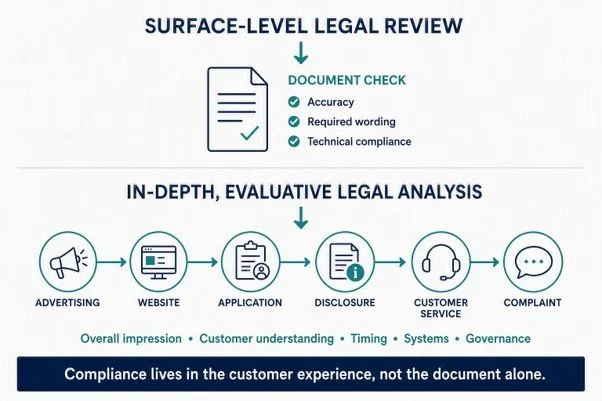
A customer can be misled even when every sentence in a document is true.
That is what makes some compliance failures so difficult to identify.
When a product, service or customer communication is reviewed, one level of analysis focuses on the document itself.
Is the disclosure accurate?
Is the warning included?
Is the statement technically correct?
Those questions are essential. They test accuracy, required wording and technical compliance.
But a more in-depth legal review asks a further question: how does the whole arrangement operate in practice?
That requires the lawyer to look beyond the document and evaluate the full customer journey.
It means considering each point at which the organisation communicates with, influences or supports the customer:
The advertisement.
The landing page.
The onboarding process.
The disclosure.
The call centre script.
(The complaint that arrives six months later …)
ASIC and ACCC do not stop at the individual sentence. They ask what impression the conduct creates as a whole.
Each step may be individually defensible.
Taken together, they can still create an overall impression that causes concern.
That is where evaluative legal judgement becomes as important as accurate drafting.
A thorough review therefore asks questions that go beyond the words on the page:
What impression is the customer likely to take away?
What assumptions are being encouraged?
What information arrives too late to be useful?
Where does the commercial objective create pressure on customer understanding?
The document may be technically compliant.
The deeper legal task is to evaluate whether the operating reality produces the intended and legally defensible customer outcome.
The highest-risk issues I encounter are frequently found at the intersection of law, systems, governance and customer experience.
Not because anyone intended to create risk.
Because different teams are solving different problems.
The lesson for boards, executives, legal and compliance teams is simple:
Compliance does not live in the document alone.
It lives in the customer experience, and the strongest legal analysis tests both.
General commentary only. Not legal advice.