
Growth and Guardrails
A Productivity Commission speech raises uncomfortable questions about Australia's regulatory growth
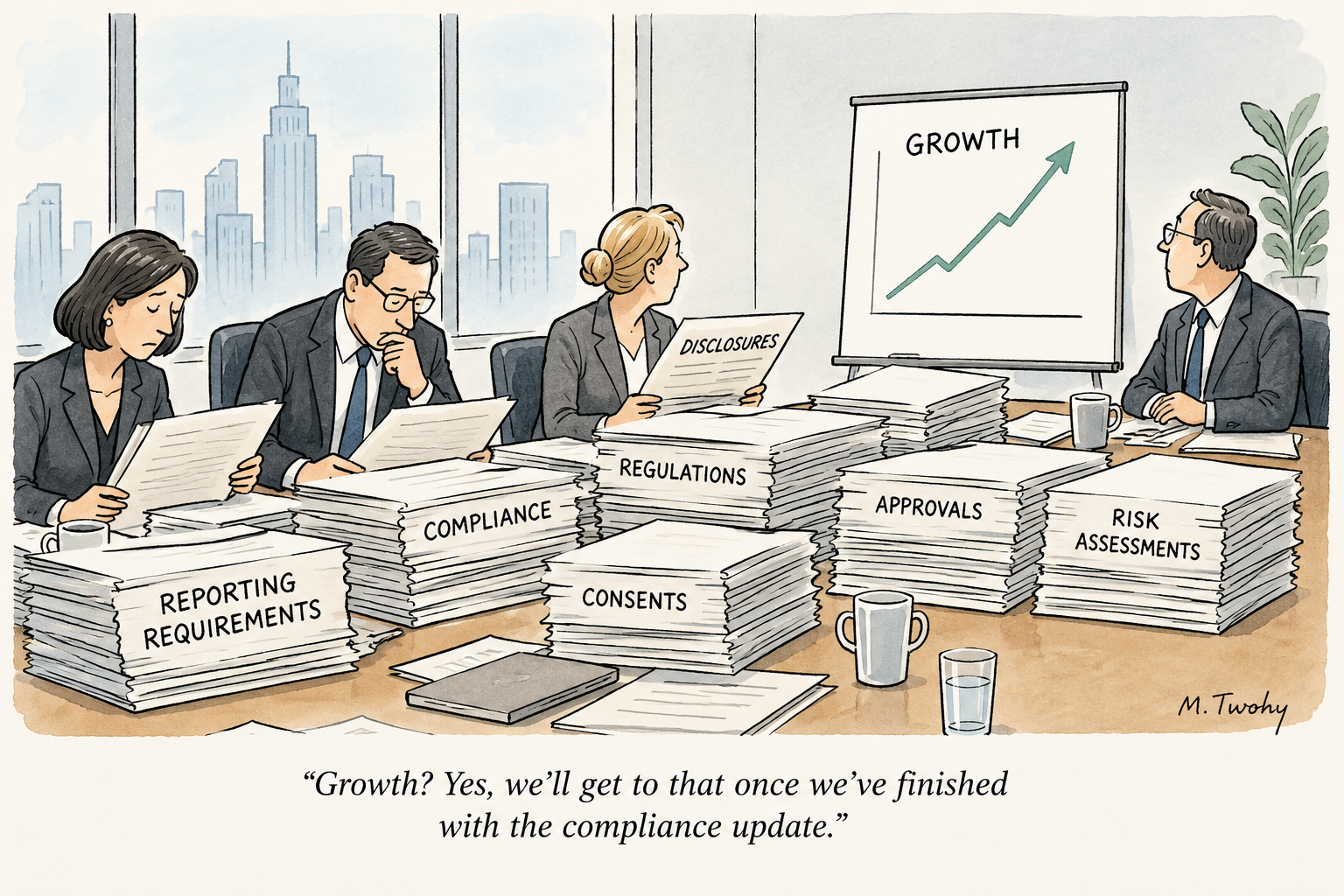
When directors gather around a boardroom table today, they spend remarkably little time discussing growth.
That was one of the more striking observations from a speech last month titled Regulating for Growth by Danielle Wood, Chair of the Productivity Commission, on the relationship between regulation and Australia's productivity challenge. According to research cited by Wood, Australian boards now spend 55% of their time on compliance activities, compared with 24% a decade ago.
For financial services businesses, that statistic is unlikely to come as a surprise: Wood noted that some of the largest increases in regulatory complexity have occurred in financial services, alongside care and utilities.
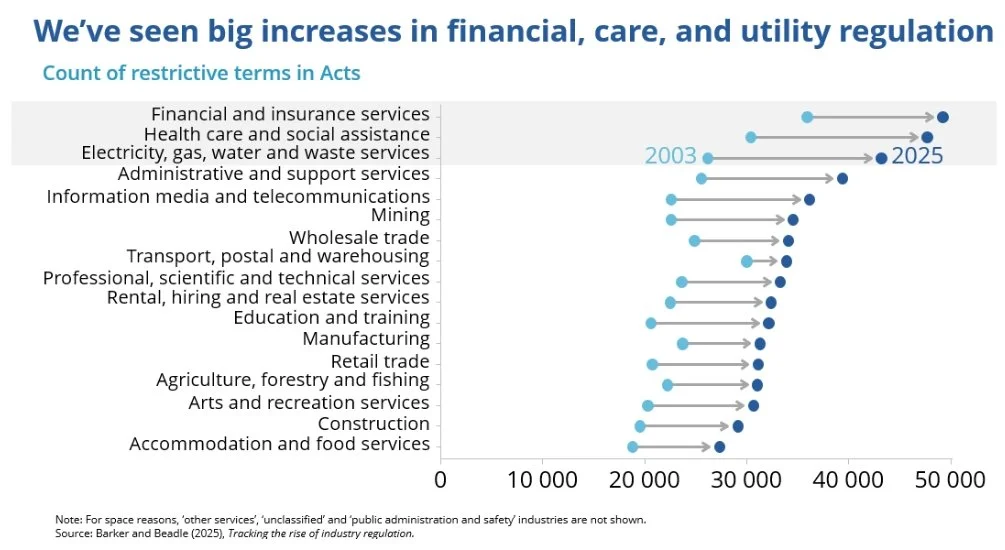
Financial services leads the pack in regulation. Graphic sourced from the Wood paper.
The accumulation problem
Over time, the accumulation of rules, reporting requirements and approval processes has created what she described as regulatory "hairballs", consuming resources simply to understand and administer.
Australia's productivity growth has slowed dramatically over the past decade. While there are many contributing factors, Wood argued that governments have increasingly pursued worthy objectives such as consumer protection, environmental outcomes and risk mitigation without giving equal attention to the effect those decisions have on economic growth.
That observation is particularly relevant to financial services, an industry that has experienced successive waves of regulation following the Global Financial Crisis, the Hayne Royal Commission and a series of consumer protection initiatives.
While individual reforms may be defensible, Wood noted the challenge was that regulation is rarely assessed cumulatively. Each additional safeguard appears reasonable when viewed in isolation. The aggregate effect is less frequently considered.
The politics of risk aversion
A recurring theme throughout the speech was society's increasing intolerance for risk.
When something goes wrong, the political response is often swift: a new reporting obligation, an additional approval process or another layer of oversight. The public understandably wants reassurance that a problem will not reoccur. Yet Wood questioned whether policymakers sufficiently examine the trade-off involved. Measures designed to reduce risk today can impose substantial costs on innovation, investment and productivity tomorrow.
Her observation touches on a difficult question for financial services. Have we reached the point where the system is optimised primarily to prevent errors rather than facilitate outcomes?
The answer matters because regulation has consequences beyond compliance expenditure. Time spent managing obligations is time not spent serving clients, investing in technology, developing new products or pursuing growth.
Compliance as a competitive advantage
There is also a competitive dimension.
One of the more interesting comments in Wood’s speech was that compliance costs can become "a better competitive moat than any oligopolist could dream up". Large institutions possess legal teams, risk departments and compliance functions capable of absorbing additional requirements. Smaller firms and new entrants do not.
Regulation intended to improve competition may, over time, entrench incumbents by raising barriers to entry. In effect, regulatory complexity can operate as a subsidy for scale.
Rebalancing growth and protection
Wood did not argue for reducing consumer protections. Rather, her speech was a reminder that regulation involves trade-offs and that those trade-offs should be measured honestly. Regulators and policymakers should assess not only the risks of doing something, but also the costs of delay, caution and inaction.
Wood welcomed recent efforts by the Federal Government to place greater emphasis on growth and dynamism within the expectations set for ASIC and APRA, and called for greater discipline in measuring and constraining future regulatory growth.
The implication of her speech is that if over-regulation has become a real contributor to Australia's productivity problem, then productivity improvement will ultimately require not merely better regulation, but less regulation in areas where the costs exceed the benefits.
Until that happens, financial services firms must continue navigating one of the most complex regulatory environments in the economy.
Our role at Dwyer Harris is to help make that process simpler. Whether dealing with licensing obligations, compliance frameworks or regulatory change, we help businesses cut through complexity and focus more of their time on clients, growth and strategic priorities.
Contact us if you need assistance with regulation.
This article is general information only and is not legal advice.